
The first “knives” were flint and obsidian with sharp edges and used about 2.6 million years ago. There is evidence of even earlier stone tools around 3.3 million years ago. They were wrapped in leather so the people (well, hominids, but hominids were people, too!) could hold them without slicing their hands. They were pretty inventive way back then. If you’ve ever touched a flint cutting tool or arrow, you’d know those things were sharp. These rudimentary tools were used for skinning animals and preparing food. That would be raw food since it was well over a million years before the controlled use of fire. Which came first, the knife or fire? Well, now we know.
Knife Evolution Timeline by Age/Industry
- Early Stone Age / Lower Paleolithic / Oldowan (~2.6–1.7M ya, “ya” means ‘years ago’ – very technical ha, ha): Homo habilis – Simple stone flakes, choppers as basic knives.
- Early Stone Age / Lower Paleolithic / Acheulean (~1.76M–250K ya): Homo erectus – Bifacial handaxes, symmetrical cutting tools.
- Middle Stone Age / Middle Paleolithic / Mousterian (~300K–50K ya): Neanderthals/H. Heidelbergensis – Levallois flakes, hafted knives.
- Late Stone Age / Upper Paleolithic (~50K–10K ya): Homo sapiens – Prismatic blades, microliths with handles.
- Late Stone Age / Mesolithic (~10K–8K ya): Homo sapiens – Microlith composites, refined edges.
- Late Stone Age / Neolithic (~8K–3.3K BCE): Homo sapiens – Ground/polished stone knives, pecking/grinding.
- Chalcolithic / Copper Age (~3.3K–2K BCE): Early Homo sapiens – Copper blades, early metal tangs.
- Bronze Age (~3.3K–1.2K BCE): Bronze Age Homo sapiens – Bronze alloy knives, cast handles.
- Iron Age (~1.2K BCE–500 CE): Iron Age Homo sapiens – Forged iron/steel, quenched edges.
- Medieval / Early Modern (~500–1800 CE): Modern Homo sapiens – Pattern-welded, crucible steel knives.
- Industrial / Modern Age (1913 CE–present): Modern Homo sapiens – Stainless steel, ceramics, super alloys.
*Another note: look at how many ages there were before the modern age, and compare how much science and discovery the modern age has produced compared to all the other ages combined. We should be in awe of what the we have accomplished, AND we should proceed with great caution. Science is moving faster than human psychosocial development. We’re infants next to science, and in our baby hands, we could really screw things up.
These first cutting tools appeared in Africa at sites like Olduvai Gorge during the Early Stone Age (ESA), also called the Lower Paleolithic. Oldowan tools date to about 2.6–2.9 million years ago. Louis Leakey and her husband were the first to discover the tools at Olduvai Gorge in Tanzania in the 1930s-1960s.
Then came the Paleolithic era, and the development of knives got finer. People knapped flint to create razor-sharp blades.
Bronze Age Shift
Around 3000 BCE, metal changed everything. Mesopotamia and Egypt first produced copper, but copper is soft and easily bent. They discovered adding tin to copper made bronze, creating a much stronger knife that held an edge.
Bronze became the alloy that changed the knife and food prep around the world. In 2000 BCE, Europe, the Únětice culture ushered in the Bronze Age, where bronze knives became a status symbol. Rich graves held ornate examples, while the working folk used plain ones in the kitchen.
By the late Bronze Age, casting improved shapes. Hollow handles were sometimes filled with weights to balance the blade. Edges were honed to near-modern sharpness. However, bronze is prone to corrosion in humid areas, and this created a push toward iron. This transition happened around 1200 BCE, with the Sea Peoples invasions disrupting the tin trade.
The Iron Age Advances
The Iron Age began in 1200 BCE, and iron knives outperformed bronze. Iron was cheaper and stronger. Bloomery furnaces produced wrought iron for new tools. Pattern welding layered iron and steel for strength. The Hallstatt culture in Europe made fine examples by 800 BCE.
Here, shorter blades made kitchen knives distinctly different from weapons. Roman knives had bolsters for grip. Pompeii digs show carbon steel knives in homes with handles of bone or wood. Cooks used them for food prep, and iron allowed mass knife production in forges.
The Celts and Germans refined tang construction. Blades were ground on whetstones, and edges lasted weeks with care. (Weeks? Could you imagine having to take your knives in every couple of months to get new edges! Although it helps to have wood cutting boards, not stone.) Traders carried knives across Europe, Africa, and Asia.
The Classical Era and the Specialization of the Knife – plus great music.
In ancient Greece, the best-known blade was the xiphos, a short sword used in war. It was not a kitchen tool, but it reflects the preference for straight, balanced blades. Greek knives for food prep were much smaller, usually single-edged, and made of iron.
While the Romans were pleasure-seeking decadents, they were also into practical design. Roman kitchen knives came in many shapes for slicing, chopping, and carving. Handles were made from wood, bone, or horn. Most kitchen knives were forged from simple iron, though some higher-quality blades used Noricum steel, which was valued for its ability to hold a sharp edge.
As food became a culinary experience, the need for various knife styles emerged. The Romans designed separate knives for preparing fish, meat, and vegetables. And variations developed from there.
Japanese knives became precision tools to thinly slice raw fish and vegetables, and included Santoku for chopping; Nakiri for vegetables; Yanagiba (sushi knife) for sashimi; and Deba for filleting fish.
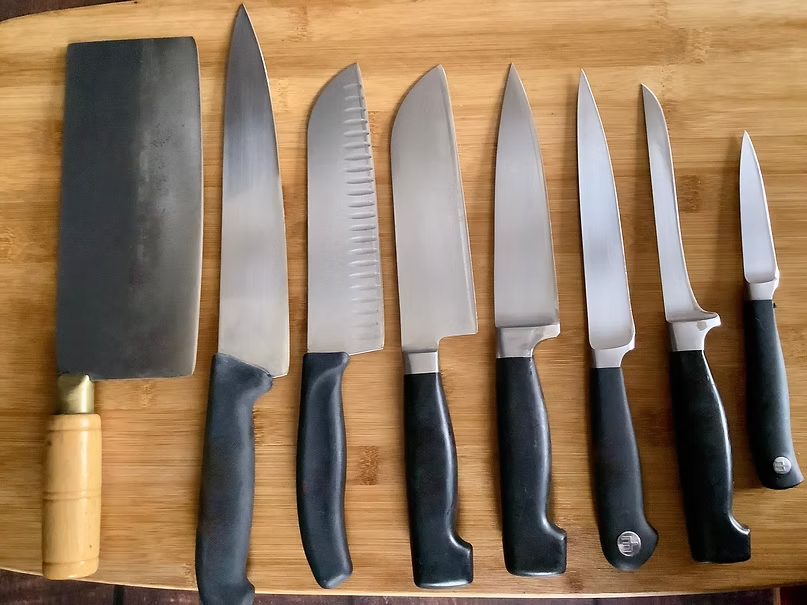
The Chinese created the Caidao (Chinese cleaver) as an all-purpose rectangular chopper for vegetables, meats, and mincing. The Indian knife, Boti, was designed for intricate carvings of vegetables and breads. The Thai cleaver has a broad blade that chops bones, meat, and shells. French chefs’ knives have straighter blades for better control, and German versions curve more for rocking cuts. Italians have the Mezzaluna for mincing herbs and soffritto, and the Maniago or Scarperia for general use.
Medieval Forging
During the Middle Ages, blacksmith guilds formed, and pattern welding became common, where twisted iron and steel layers were combined to improve strength and appearance. The viking seaxes often were often used for both utility and the kitchen.
Cultural exchange during the Crusades spread ideas about steel, and by the 1400s, personal table knives were common in Europe. Guests often brought their own knives to meals, but no forks yet.
The Renaissance and Early Modern Era
The Renaissance elevated the aesthetics in life, including with the knife. They made the knife fancy and beautiful. Brescia’s knives featured intricately carved silver handles. And the Damascus-style folded blades were designed for superior strength. New vegetables like tomatoes and potatoes needed versatile tools, and so the paring knife was born.
Industrialization and Standardization in Northern Europe
Germany was a pioneer with industrialized production using river-powered grindstones. Solingen’s guilds established rigorous quality standards. And in the 1600s, Sheffield, England, made advances by the by using crucible steel to produce harder knives. Forks gained popularity around this time, prompting knives to shorten their points for safer table use. There was no longer a way to accidentially-intentially stab your seat mate if they were encroaching on your space.
French Innovations and Reforms
In 1669, Louis XIV mandated rounded tips on table knives, curbing stabbings – apparently, dining was a risky endeavor prior to the 1600s – at Versailles and introduced dining etiquette in Europe. Kitchen knives remained pointed for utility but adopted refined designs, with improved ergonomics through bolsters and contoured scales.
Industrial Revolution Mass Production
In the 1700s, factories used steam hammers to stamp out knife blanks. Carbon steel soon became the standard, and Sheffield makers marked their blades with “cast steel.” American forges in New England began competing in the trade, and by the 1830s, firms such as Rogers Brothers were mass-producing knives on an industrial scale.
As railroads opened up the world and trade, cheap 8-12 inch knives became common, and culinary schools were on the rise and needed knife sets. By the 1880s, power grinders became the norm, and edge angles were precise. Knives were now affordable for the average home kitchen.
20th Century Metallurgy
Then came stainless steel, changing knives forever. Harry Brearley, in August 1913, melted a steel with about 12.8% chromium and 0.24% carbon at Brown-Firth in Sheffield, which resisted rust and excelled in cutlery.
In the 1970s, powder metallurgy started the Crucible Particle Metallurgy (CPM) process, which included fine, evenly distributed carbides creating tough, wear-resistant knives, and the standard spread worldwide. Knives became affordable for the home cook and brands like Wüsthof were available.
Modern-day knives are designed to meet regional needs.
- Germany (Solingen): Renowned for durability (e.g., Wüsthof, Zwilling J.A. Henckels). They have thicker, heavier blades, often with a curved belly for rocking, making them ideal for all-purpose, heavy-duty tasks.
- Japan (Seki/Sakai): Focused on sharpness and edge retention, using harder, thinner steel (e.g., Shun, Global, MAC). Common styles include the Gyuto (chef’s knife), Santoku (multi-purpose), and Nakiri (vegetable knife).
- France (Thiers): Known for the K Sabatier style, which typically features a thinner blade than German knives, offering a balance between strength and precision, often with a more tapered tip.
- China: The Chinese chef’s knife (often incorrectly called a cleaver, like the CCK brand) is a versatile, rectangular tool used for nearly all slicing, chopping, and mincing tasks.
- Italy (Maniago): Known as the “City of Knives,” Italy produces high-quality, often modern, stainless steel cutlery, frequently with a focus on ergonomic design.
- Other Regional Knives:
- Argentina: The Gaucho knife is a versatile tool for slicing meat.
- Nepal: The Kukri is a distinct, forward-curved knife for heavy chopping.
- Thailand: Kiwi knives are popular for being affordable, thin, and versatile.
- Uzbekistan: The Pchak is a traditional, broad-bladed, high-carbon utility knife.
In Italy, knives reflect regional cuisine; for example, Bolognese chefs use sturdy blades for prep, while Emilia-Romagna cooks use carbon steel with its keen edge, although it does get rusty. Modern sets add slicers and bird’s-beak peelers (this I never heard of before, and I’ve never, nor will I, peel a bird’s beak).
From survival tools to artisanal craft, knives have had a long and considerable evolution. The future promises smart alloys and self-sharpening edges.
The most important quality of a knife is how it feels in your hand, and that is it SHARP. While it may seem counterintuitive, dull blades are more dangerous – and frankly frustrating to use.

Here’s a 15% off coupon for beautiful Seido Knives.
They have a great selection!